
Signs Your Leg Pain May Actually Be Sciatica: What to Watch For
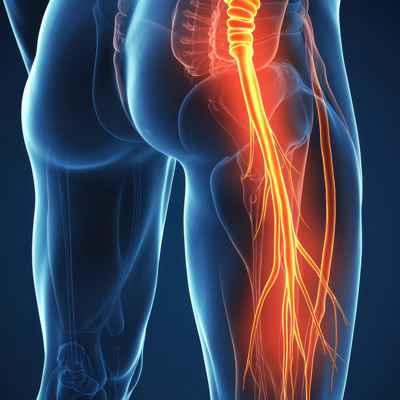
Your leg has been hurting for days. It’s not just soreness – something feels different. Maybe there’s tingling. Maybe sharp shooting pain. Maybe numbness.
You’re wondering: Is this sciatica? Or is it something else?
The confusion is understandable. Leg pain can come from many sources. But certain patterns suggest the problem originates in your spine, specifically affecting the sciatic nerve. Recognizing these patterns helps you understand what’s happening and whether professional evaluation makes sense.
This guide shows you how to identify whether your leg pain may actually be sciatica.
What Is Sciatica?
Sciatica isn’t a diagnosis – it’s a symptom pattern describing nerve-related leg pain originating from the sciatic nerve.
Your sciatic nerve is the longest nerve in your body, running from your lower back through your buttocks and down each leg. When something irritates or compresses this nerve, pain radiates down your leg – sometimes all the way to your foot.
Key distinction: Sciatica describes how pain travels, not necessarily why. The actual cause might be a herniated disc, spinal misalignment, muscle compression, or inflammation. Understanding the cause determines appropriate treatment.
10 Key Signs Your Leg Pain May Be Sciatica
Classic sciatica pain follows recognizable patterns:
- Pain travels from the lower back through the buttock down the leg. Unlike localized muscle pain, sciatica typically starts in your lower back or buttock and radiates downward. The path usually follows one side of your body.
- Pain shoots or radiates rather than dull aches. Sciatica often feels like sharp shooting pain, electrical sensations, or burning – not the muscle soreness you’d feel from overuse.
- Numbness or tingling in your leg or foot. Nerve compression creates unusual sensations – pins and needles, numbness, or “falling asleep” feelings that persist even when resting.
- Sitting makes it worse. Sciatica often worsens when sitting, especially prolonged sitting common for office workers and commuters in Redlands. Sitting compresses the nerve further.
- Certain movements trigger pain. Bending forward, twisting, or specific leg movements intensify sciatic pain. Other movements (like walking) might provide relief.
- Pain may be on one side only. Sciatica typically affects one leg at a time, not both simultaneously. One-sided pain suggests nerve involvement.
- Symptoms come and go. Unlike constant muscle strain, sciatica often appears suddenly, worsens with certain activities, then improves with position changes or rest.
- Pain worsens at night or early morning. Many people experience sciatica intensifying when lying down or first waking. Inflammation increases during rest.
- Weakness or difficulty moving the leg. Advanced nerve compression can cause foot drop, weakness walking, or difficulty lifting your foot. This warrants prompt evaluation.
- Pain extends below the knee. Sciatica frequently extends past the knee into your calf or foot. Localized hip or thigh pain might indicate other issues.
Sciatica vs. Other Leg Pain: What’s the Difference?
Not all leg pain is sciatica. Understanding differences helps identify your actual problem.
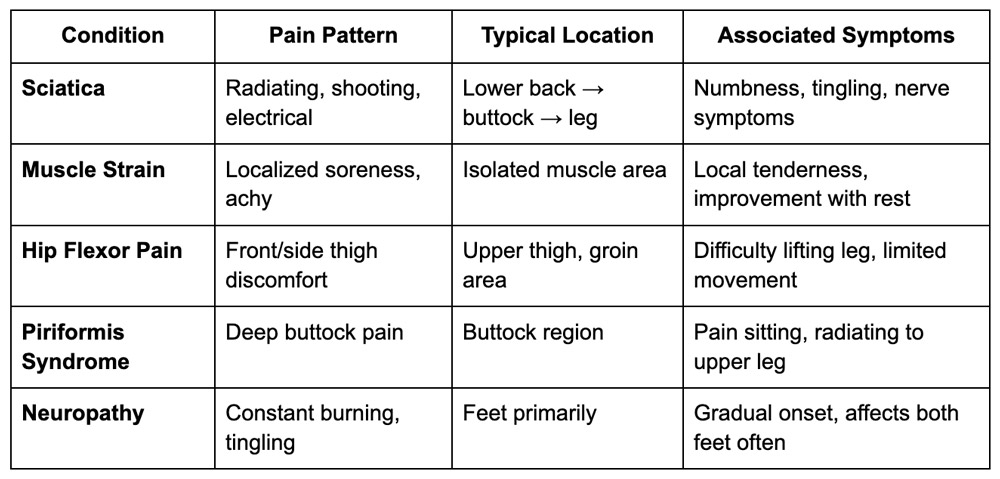
Key question: Does your pain follow the sciatic nerve’s path, or is it localized to one area? Sciatica travels. Muscle strain stays put.
Common Causes of Sciatica
Understanding causation helps treatment planning.
Herniated disc is the most common sciatica cause. When spinal disc material protrudes, it presses on the nerve root.
Spinal misalignment can irritate or compress the nerve. Vertebrae out of position directly affect nerve function.
Piriformis muscle tightness is often overlooked. A tight muscle in your buttock can compress the sciatic nerve as it passes nearby.
Spinal stenosis narrows the space where nerves pass, creating compression. This is more common as we age.
Inflammation around the nerve root causes symptoms. Inflammatory response to injury or irritation irritates the nerve.
Prolonged sitting or poor posture contributes significantly. Office workers and commuters often develop sciatica from sustained positioning. Slouching compresses spinal discs.
When Sciatica Might Improve on Its Own
Not all sciatica requires treatment. Some cases improve with time and self-care.
Sciatica may resolve if:
- Inflammation decreases naturally
- You modify activities irritating the nerve
- You improve posture and ergonomics
- You stay consistently active appropriately
However, sciatica often persists if:
- The underlying cause remains unaddressed
- You continue habits that irritate the nerve
- Structural issues (misalignment, herniation) aren’t resolved
This is why identifying the actual cause matters. Temporary relief doesn’t equal a lasting solution.
Red Flags: When Sciatica Requires Urgent Care
Most sciatica isn’t emergency-level urgent. But certain symptoms warrant immediate evaluation:
Seek immediate care if you experience:
- Sudden severe pain
- Sudden paralysis or complete leg weakness
- Loss of bowel or bladder control
- Fever accompanying leg pain
- Pain following serious injury or accident
- Numbness in your genital area
These suggest serious conditions beyond typical sciatica. Emergency evaluation ensures you receive appropriate care.
How Ray Chiropractic Evaluates Sciatica
Dr. Ray Sahawneh uses a comprehensive approach identifying whether your leg pain actually involves nerve irritation.
Evaluation includes:
- Detailed symptom assessment – Understanding your pain pattern, triggers, and what provides relief.
- Neurological screening – Testing nerve function to confirm nerve involvement. This determines whether the problem is truly nerve-related.
- Movement assessment – Identifying which positions and movements affect your pain. This reveals potential causes.
- Spinal examination – Checking vertebral alignment, disc position, and nerve irritability. Hands-on assessment detects structural issues.
- Imaging if needed – X-rays or other imaging clarify structural problems when examination findings warrant it.
Based on findings, Dr. Sahawneh develops a root-cause treatment plan. Rather than managing symptoms temporarily, the goal is addressing what’s causing the nerve irritation.
Next Steps: Understanding Your Leg Pain
If your leg pain matches these sciatica patterns – traveling down your leg, causing tingling or burning, worsening with sitting, coming and going unpredictably – evaluation can determine what’s actually happening.
Understanding your problem is the first step toward relief. At Ray Chiropractic, Dr. Ray Sahawneh helps patients identify causes and develop personalized solutions.
If your leg pain is traveling, tingling, burning, or repeatedly returning, it may be worth finding out whether the issue is actually coming from your spine.
Schedule a sciatica evaluation at Ray Chiropractic. Online scheduling or call to discuss your symptoms
Frequently Asked Questions
Can sciatica cause pain below the knee?
Yes. True sciatica often extends below the knee into the calf or foot. Pain limited to the hip or thigh may indicate different issues.
Is walking good for sciatica?
Often yes. Gentle walking frequently provides relief. However, avoid high-impact activities that worsen symptoms. Listen to your body.
Can sciatica come and go?
Absolutely. Many people experience episodic sciatica – pain appearing, resolving, then returning. This pattern suggests an underlying issue intermittently irritating the nerve.
Is sciatica always caused by a herniated disc?
No. While disc herniation is common, sciatica also results from misalignment, muscle tightness, inflammation, or spinal narrowing. Diagnosis identifies your specific cause.
Can sciatica affect both legs?
Typically no. Sciatica usually affects one leg. Pain affecting both legs suggests different conditions requiring medical evaluation.
Should I see a chiropractor for leg pain?
If your leg pain involves radiating, burning, or tingling sensations – especially following your sciatic nerve’s path – chiropractic evaluation may help. A chiropractor assesses whether structural issues are involved.
Dr. Ray Sahawneh is a chiropractor and owner of Ray Chiropractic in Redlands, serving patients since 2007. This article is educational and does not replace professional medical advice. Consult a healthcare provider about persistent leg pain or neurological symptoms.
References:
- Ropper, A. H., & Zafonte, R. D. (2015). “Sciatica.” New England Journal of Medicine, 372(13), 1240–1248.
- Valat, J. P., et al. (2010). “Sciatica.” Best Practice & Research Clinical Rheumatology, 24(2), 241–252.
- Stafford, M. A., et al. (2007). “Sciatica: A review of epidemiology, pathophysiology, and evidence-based treatments.” Journal of Spinal Disorders & Techniques, 20(6), 482–491.
