
Back Pain From Golf: What to Do When Golfing Hurts Your Back

Back pain from golf can start during a swing, near the end of a round, or the next morning. Repeated rotation, limited hip mobility, muscle fatigue, and an existing back problem can all play a role.
At Ray Chiropractic in Redlands, CA, we look at how your body moves as well as where it hurts. Here is what you can do when golf leaves your lower back sore and how to reduce the chance of it happening again.
Why does your back hurt after playing golf?
A golf swing requires your hips, upper back, lower back, and trunk muscles to work together. Problems can develop when one area has to compensate for another.
Common reasons include:
- Repeated twisting. Dozens of swings and practice swings can gradually fatigue the muscles around your lower back.
- Limited hip mobility. If your hips do not rotate well, your lower back may take on more of the movement.
- Muscle fatigue. As your trunk muscles tire, controlling rotation through the swing may become harder.
- Swing mechanics. Patterns such as reverse spine angle or early extension may place additional stress on the back.
- An existing back problem. Golf may aggravate an area that was already sensitive.
If pain appears during the same part of your swing every time, pay attention to that pattern rather than simply trying to swing through it.
The first 72 hours after golf related back pain
You do not necessarily need complete bed rest. The goal is to reduce movements that aggravate your back while gradually returning to comfortable activity.
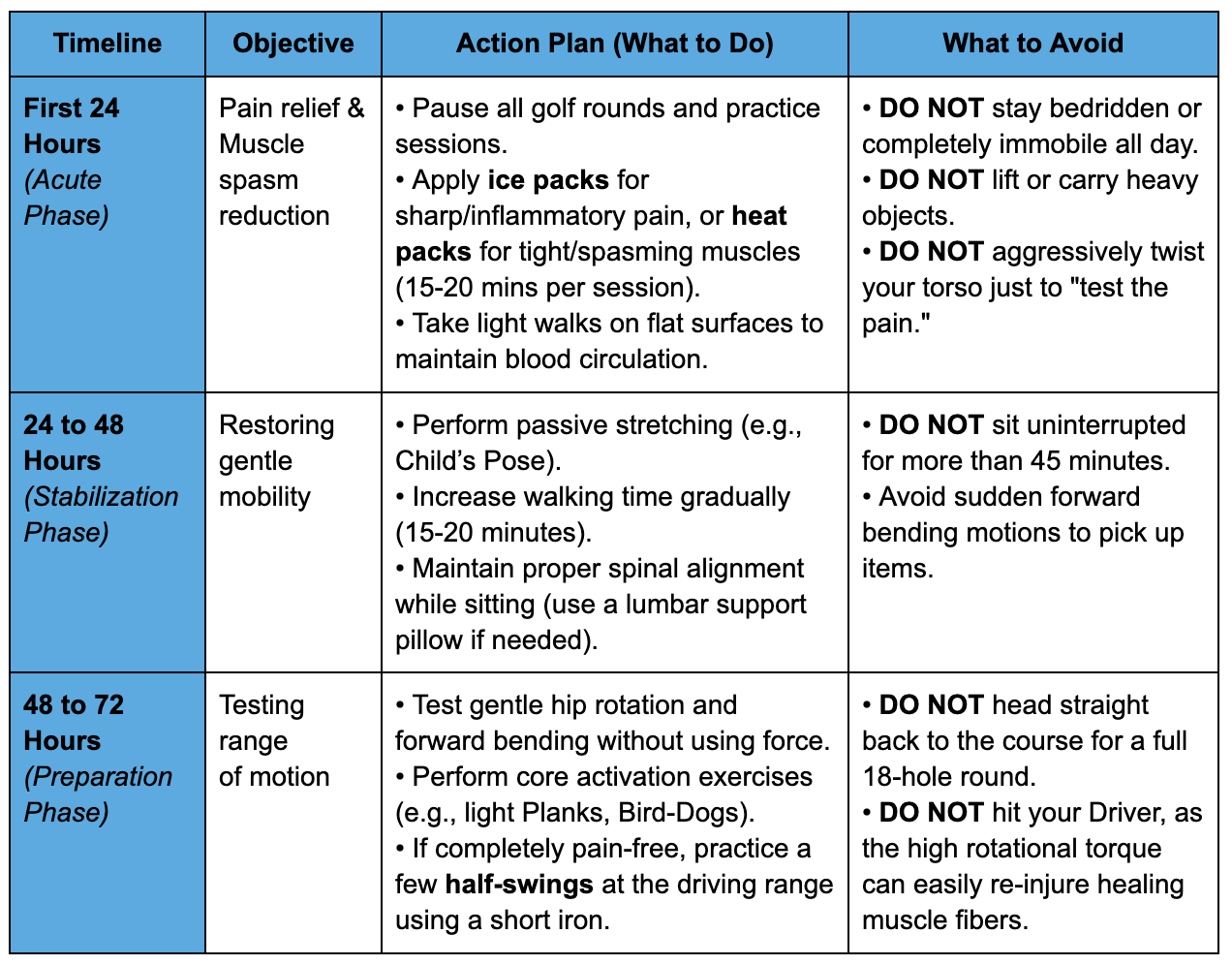
Seek prompt medical attention rather than waiting 72 hours if you develop significant weakness, loss of sensation, bowel or bladder changes, or numbness around the groin or saddle area.
3 targeted stretches for immediate lower back pressure relief
After the first 24 hours of rest, once sharp pain subsides into a general stiffness, perform these 3 stretches. They help decompress spinal discs, relax spasming muscles, and safely restore natural range of motion to your spine.
Stretch 1: Child’s Pose – Full-Back Decompression
This pose provides passive traction to your lower back, widening the space between your vertebrae to relieve nerve compression.
How to do it:
- Kneel on the floor, touch your big toes together, and open your knees wide.
- Fold your torso forward, lowering your glutes toward your heels.
- Extend your arms out ahead, placing your palms flat on the floor.
- Rest your forehead on the ground, relaxing your shoulders and lower back completely.
Duration: Hold the position and breathe deeply for 30 to 60 seconds.
Golfer’s Tip: Crawl your fingertips forward an extra 1-2 cm with every exhale. This deepens the stretch in your latissimus dorsi (lats), a muscle group heavily loaded during the golf swing.
Stretch 2: Cat-Cow – Spinal Mobility Restoration
This dynamic movement lubricates spinal facet joints, instantly relieving that stiff, locked-up feeling after hours of standing and twisting on the course.
How to do it:
- Start on all fours in a tabletop position (hands directly under shoulders, knees under hips).
- Cow Pose (Inhale): Drop your belly toward the floor, lift your chest and tailbone toward the ceiling, and look slightly upward.
- Cat Pose (Exhale): Pull your belly button toward your spine, round your back toward the ceiling, and tuck your chin toward your chest.
Duration: Flow smoothly between the two positions for 10 to 15 full breath cycles.
Golfer’s Tip: Do not force maximum range of motion if you feel a pinch. Keep the movement small and rhythmic to encourage synovial fluid flow, softening the spinal segment.
Stretch 3: Figure 4 Stretch – Hip and Glute Release
A stiff hip joint is the number one cause of the lower back over-rotating and injuring itself. This stretch opens the hip capsule and releases the glutes, indirectly taking the mechanical load off your lumbar spine.
How to do it:
- Lie flat on your back with your knees bent and feet flat on the floor.
- Rest your right ankle across your left knee, forming a “4” shape.
- Thread your hands behind your left thigh, gently pulling it toward your chest until you feel a deep stretch in your right glute.
- Keep your head and shoulders relaxed flat on the floor.
Duration: Hold for 30 seconds per side, then switch legs.
Golfer’s Tip: If your hips are too tight to reach your thigh while lying down, do this seated on a chair. Cross your ankle over the opposite knee and lean your torso slightly forward.
Long term ways to prevent back pain from golf
Once your back has settled, the next step is preparing your body for the repeated bending, rotation, and force involved in golf.
Warm up before you play
Spend about 10 minutes getting your body moving before your first full swing.
Focus on gentle movements for your hips, upper back, and shoulders. Start with easy practice swings and gradually increase your speed rather than stepping onto the tee and immediately swinging at full effort.
Build strength away from the course
Golf requires your trunk and hips to control rotation throughout the swing. Exercises such as planks and bird dogs can help build strength and control around your trunk.
You do not need a long workout. Consistent strength and mobility work between rounds can help prepare your body for the demands of golf.
Reduce unnecessary strain on the course
Small changes during a round can also reduce stress on your back:
- Use a push cart instead of carrying a heavy golf bag if carrying increases your symptoms.
- Use your hips and knees when picking up balls instead of repeatedly bending through your lower back.
- Ask for help with your bag or equipment if your back is still sensitive.
- Avoid jumping straight into 18 holes after several weeks away from golf.
- Stop if your pain is clearly getting worse as the round continues.
The goal is not to avoid movement. It is to make sure your body is prepared for the amount of golf you are asking it to handle.
When recurring golf back pain should be checked
One sore round does not necessarily mean something is seriously wrong. What matters more is whether the pain improves or keeps returning.
Consider an evaluation if:
- Pain returns every time you golf.
- You have to change your swing because of the pain.
- Symptoms are getting worse instead of better.
- Pain travels into your buttock or leg.
- You develop numbness, tingling, or weakness.
- Pain starts affecting sleep or normal daily activities.
If these symptoms keep returning, it may be worth looking beyond temporary soreness to understand what is contributing to the problem.
How Ray Chiropractic approaches golf related back pain
At Ray Chiropractic, the evaluation looks beyond where your back hurts. We consider how your symptoms relate to the movements and physical demands of golf, including:
- When the pain starts, such as during the swing, later in the round, or afterward.
- Posture and spinal movement and whether certain positions reproduce your symptoms.
- Hip and trunk mobility and how these areas move together.
- Strength and stability around the trunk and hips.
- Pain triggering movements, including bending, rotation, and other sports specific motions.
Depending on your findings, care may include chiropractic treatment, soft tissue therapy, and therapeutic exercises to support mobility, strength, and movement control.
Ray Chiropractic also provides care for sports related injuries, with the goal of identifying factors that may be contributing to recurring pain and helping you return to your activities more comfortably.
Address back pain before it affects your game
Back pain from golf may improve with rest and simple changes, but recurring pain can be a sign that something in your mobility, strength, or movement needs more attention.
If back pain keeps returning after you play, affects your swing, or limits your daily activities, contact us to schedule an evaluation and find out what may be contributing to it.
Frequently asked questions
Can I play golf with lower back pain?
Mild symptoms that are improving may allow a gradual return. Stop if swinging clearly increases the pain or causes symptoms to travel into your leg.
Can carrying a golf bag make back pain worse?
It can add extra load during a round. If carrying your bag increases symptoms, using a push cart may be more comfortable.
Should I stretch my back before golfing?
A warm up should involve more than stretching your lower back. Include gentle movement for your hips, upper back, and shoulders before progressing to full swings.
