
Sciatica vs Piriformis Syndrome: How to Tell the Difference
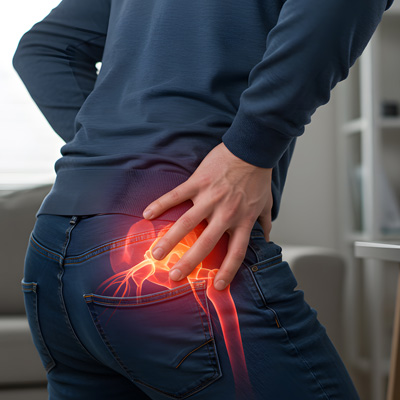
Sciatica vs piriformis syndrome can be easy to confuse, especially when pain starts in the buttock and travels down the leg.
Both conditions can affect the sciatic nerve and cause similar symptoms. However, the source of the pain is different. Sciatica usually starts in the lower back, while piriformis syndrome involves the piriformis muscle deep in the buttock. Understanding this difference can help guide the right approach to care instead of focusing only on where the pain is felt.
What is sciatica?
The sciatic nerve is the largest nerve in your body. It forms from roots in the lower spine, runs through the hip, and travels down the back of each leg to the foot.
Sciatica is a symptom, not a diagnosis. It describes irritation somewhere along that path, and something else is always causing it.
In most cases the trouble starts in the lumbar spine. A herniated disc presses on a nerve root. Disc degeneration narrows the space a nerve travels through. Spinal stenosis or foraminal narrowing squeezes it from the side. Poor alignment adds to it.
Symptoms of sciatica usually include pain that radiates below the knee, burning or electric sensations, loss of feeling, a tingle in the foot or toes, and sometimes weakness in the leg. Sitting for long stretches makes it worse.
What is piriformis syndrome?
The piriformis is a small muscle deep in the buttock, running from the sacrum to the top of the thigh bone. It stabilises the hip and lets your leg rotate when you walk, climb stairs, or change direction. The sciatic nerve passes right underneath it, and in some people straight through it.
Piriformis syndrome occurs when the piriformis muscle tightens, spasms, or swells and presses on the sciatic nerve. Unlike true sciatica, it starts in the muscle rather than the spine.
Causes are muscular. Overuse from running or cycling. Hours on a hard chair or a wallet. A fall onto the hip. Weak glutes that force the piriformis to work overtime.
Symptoms centre on deep buttock pain and tenderness when you press the spot. It flares while sitting or climbing stairs, and it can radiate partway down the leg.
One thing worth knowing. Piriformis syndrome is a diagnosis of exclusion. It gets confirmed by ruling other things out, not by a single test. It is also far less common than the internet suggests.
The difference between sciatica and piriformis syndrome
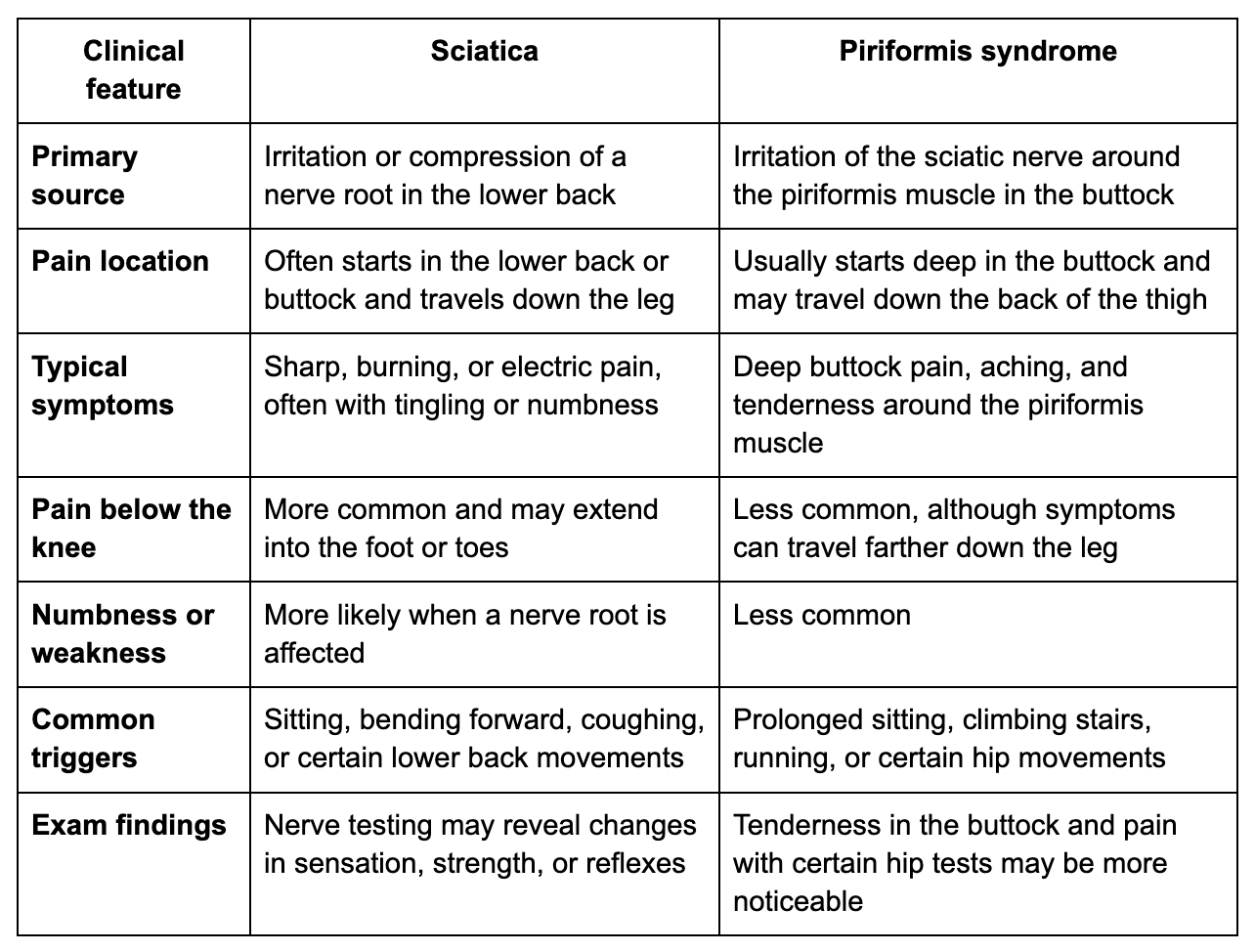
Neither column is a diagnosis. It is a starting point for a conversation with someone who can examine you.
Can you have both?
Yes, and it happens more than people expect.
When a disc or joint problem changes how you walk, your hips start compensating. That means muscles working in ways they were not built for. The piriformis is a common casualty.
So the piriformis muscle tightens because of a spinal problem, and now you have two sources of pressure on the sciatic nerve. Treat only the muscle and the pain returns. Treat only the back and the deep ache stays.
This is exactly why a real evaluation beats a guess.
How chiropractors tell them apart
A chiropractor will look at where the pain starts, how it travels down the leg, and what makes the symptoms worse to identify the source of sciatic nerve irritation.
If the pain starts in the lower back, travels below the knee, and comes with numbness, tingling, or leg weakness, sciatica is more likely. A straight leg raise test may also reproduce symptoms when a nerve root in the lower back is irritated.
Piriformis syndrome, on the other hand, usually causes deep pain and tenderness in the buttock. Symptoms may get worse with prolonged sitting, climbing stairs, or movements that stress the piriformis muscle. Neurological tests are also less likely to show abnormal findings than with sciatica.
A chiropractor may combine these findings with tests of reflexes, sensation, muscle strength, range of motion, and spinal movement. X-rays may be recommended when more information is needed to evaluate the cause of the symptoms.
Chiropractic care for sciatica and piriformis syndrome
Treatment options follow the cause, which is the entire reason for the workup.
When the problem starts in the back
Care combines adjustments to restore motion at the affected segments, corrective spinal work, spinal decompression when the exam supports it, mobility work, and postural correction.
When the problem starts in the muscle
The focus shifts to soft tissue therapy through the hip, stretching the piriformis muscle, hip mobility work, and strengthening the glutes so the piriformis stops covering for them. Adjustments still play a part when spinal mechanics are feeding the problem.
The aim across both is the same. Take pressure off the sciatic nerve, restore normal movement, and build enough strength that it does not come straight back.
See more: Can a Chiropractor Help with Sciatica?
Tips to prevent future flare ups
- Stay active when you can. Gentle walking is usually more helpful than long rest for this kind of pain.
- Stretch your hips several times a week rather than only when something hurts.
- Break up long sitting every 30 to 45 minutes.
- Strengthen your core and glutes, which is what stops the piriformis overworking.
- Lift with your hips and knees, not your back.
- Take the wallet out of your back pocket.
- Stick with the corrective exercise program past the point where you feel better.
Why choose Ray Chiropractic for a sciatica evaluation?
At Ray Chiropractic, care starts with identifying the cause of your symptoms. New patients receive a consultation, neurological and orthopedic exams, and X-rays when needed before a treatment plan is recommended.
Depending on the exam findings, care may include chiropractic adjustments, spinal decompression therapy, massage therapy, and therapeutic exercises. This is especially important because sciatica and piriformis syndrome can cause similar symptoms but have different underlying causes.
Dr. Rayed Sahawneh has served the Redlands community since 2007. If you are looking for a chiropractor in Redlands for persistent back, buttock, or leg pain, Ray Chiropractic can help identify the cause and recommend an appropriate approach to care.
Conclusion
Sciatica and piriformis syndrome can feel similar, but the source of the pain is different. That difference decides what type of care makes sense. If pain travels from your lower back or buttock into your leg and has not improved, an examination can identify what is irritating the sciatic nerve.
At Ray Chiropractic in Redlands, we take the time to evaluate the source of your symptoms before recommending care. If you are dealing with persistent back, buttock, or leg pain, call us to schedule an evaluation and find out what may be contributing to your symptoms.
Frequently asked questions
Is piriformis syndrome the same as sciatica?
No. Sciatica describes irritation of the sciatic nerve, while piriformis syndrome is one specific cause of it. Most sciatica comes from the lower back instead.
Does sciatica always come from a herniated disc?
No. Spinal stenosis, foraminal narrowing, joint problems, and piriformis syndrome all produce similar symptoms. That one is just the most familiar culprit.
Can chiropractic help with sciatica?
It helps most when the problem is mechanical, which covers a large share of cases. An exam first tells you whether you are in that group.
When should I seek professional treatment?
When the pain has lasted more than a week, keeps coming back, or is affecting sleep. Earlier is easier for both conditions.
